Loading Experience...

Precision Engineering, Minimal Footprint

Our proprietary software enables us to optimize every meter of trail while calculating rider speeds, trajectories, and material volumes in real-time. This means we adapt to the terrain's natural features instead of fighting them — delivering better riding experiences with less environmental disruption.

Environmentally responsible by design: We dig only where the trail will be, using native material exclusively. Vegetation strips are preserved, side slopes are restored with original topsoil, and our hydrological modelling ensures drainage follows natural watershed patterns — routing surface water away from the trail and into stable, natural channels. No imported fill, no unnecessary clearing — just precise earthwork that respects the landscape and satisfies environmental review requirements.

Built on Proprietary Engineering Software

29 engineered algorithms. Each one calibrated to a published standard or peer‑reviewed reference.

Our team developed our own engineering platform specifically for mountain bike trail infrastructure — combining physics simulation, terrain analysis, and construction documentation into a single, validated workflow. No general‑purpose CAD software adapted for trails. Every algorithm is calibrated to recognised civil‑engineering, hydrology, and BIM standards — so the design package stands up to permitting review, insurance assessment, and BIM coordination.

Rider Mechanics

How the trail behaves under a rider — validated before a single shovel hits the ground.

Jump Physics & Equivalent Fall Height

Every jump trajectory is computed via 4th‑order Runge‑Kutta integration including aerodynamic drag — then validated against ASTM F2291 equivalent‑fall‑height limits and the Hubbard (2009) safer‑landing methodology. Lip angle and landing curvature are matched to deliver tangent‑to‑velocity touchdown — the geometry condition that makes a jump safe to land at the speed it's actually approached at.

References: ASTM F2291‑21 · Hubbard 2009 · McNeil 2012 · IMBA Trail Solutions · ITRS difficulty grading

Rider Speed & Flow Simulation

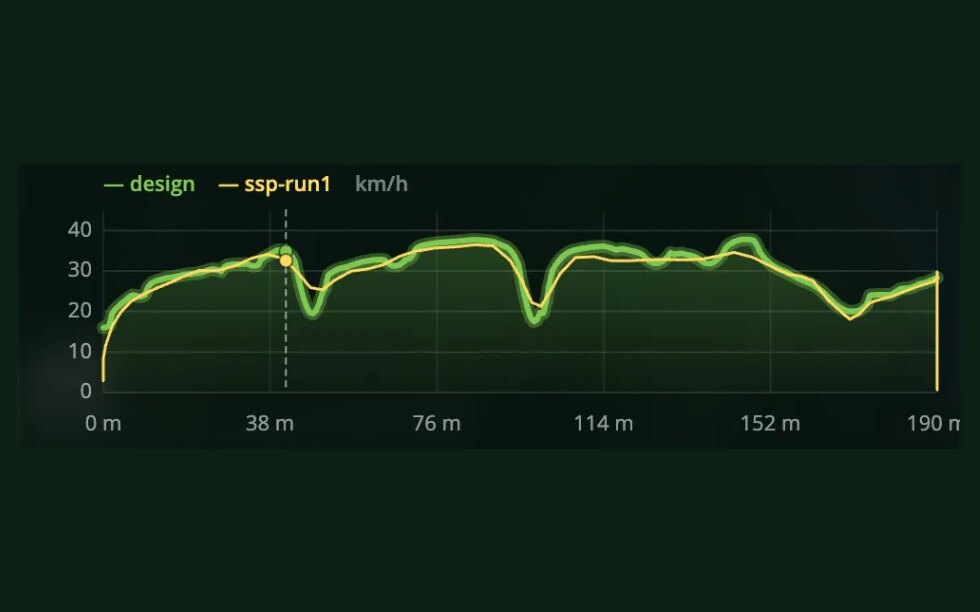
Speed is propagated continuously along the alignment using the Martin et al. (1998) cycling power model — accounting for grade, rolling resistance, drag and corner radius. Every berm, roller, and feature geometry is tuned to the speed riders actually reach there.

References: Martin et al. 1998 (J. Applied Biomechanics)

Terrain, Water & Erosion

From LIDAR to drainage — the trail engineered to work with the watershed, not against it.

Hydrological Modelling & Drainage Sizing

Catchment delineation runs on LIDAR DEMs using D8 flow routing with Priority‑Flood (Barnes et al. 2014) and Lindsay (2016) hybrid breach‑fill conditioning — preserving natural drainage through the trail corridor. Culverts are sized via Manning's equation per FHWA HEC‑22 and FAO Conservation Guide No. 13.

References: Lindsay 2016 · Barnes et al. 2014 · Chow 1959 · FHWA HEC‑22 · FAO Conservation Guide 13 · USFS BMP Handbook

Erosion & Surface Degradation Modelling

Soil loss risk is mapped per‑cell using RUSLE (USDA AH‑703) combined with the Moore & Burch (1986) Sediment Transport Index and Nobre et al. (2011) Height‑Above‑Nearest‑Drainage. Red zones — concentrated flow, near‑stream, high‑erosivity slopes — are identified and redesigned before they become maintenance problems.

References: USDA AH‑703 (RUSLE) · Moore & Burch 1986 · Beven & Kirkby 1979 · Nobre et al. 2011

Construction & Documentation

Permit‑ready engineering deliverables that satisfy civil reviewers and BIM workflows.

Earthwork Volume Calculation

Cut, fill, topsoil stripping and net haul volumes are computed cross‑section by cross‑section using the Average End Area method — the standard prescribed by FHWA Construction Manual §6.3 and the AASHTO Green Book. Volumes drive realistic budgets and eliminate the cost surprises that come from under‑estimated earthwork scope.

References: FHWA Construction Manual §6.3 · AASHTO Green Book · USACE EM 1110‑2‑1913 · Brinker & Minnick 2012

Clothoid Alignment & IFC 4x3 BIM Export

Horizontal alignments use Clothoid‑Circle‑Clothoid (Euler spiral) transitions per AASHTO §3.3.3 and EN 13803 — the same geometry used in road and rail design. The complete trail (alignment, cuts, fills, drainage) exports as IFC 4x3 (ISO 16739‑1:2024) for direct interoperability.

References: AASHTO Green Book §3.3.3 · EN 13803:2017 · ISO 16739‑1:2024 (IFC 4x3) · ISO 19650 · Uniclass 2015

The result: design intent is fully preserved from model to machine to finished trail. No field interpretation. No guesswork. What we design is what gets built — and the engineering rationale is documented to a standard a permitting officer or insurance reviewer can verify.

Six phases from concept to operational handover
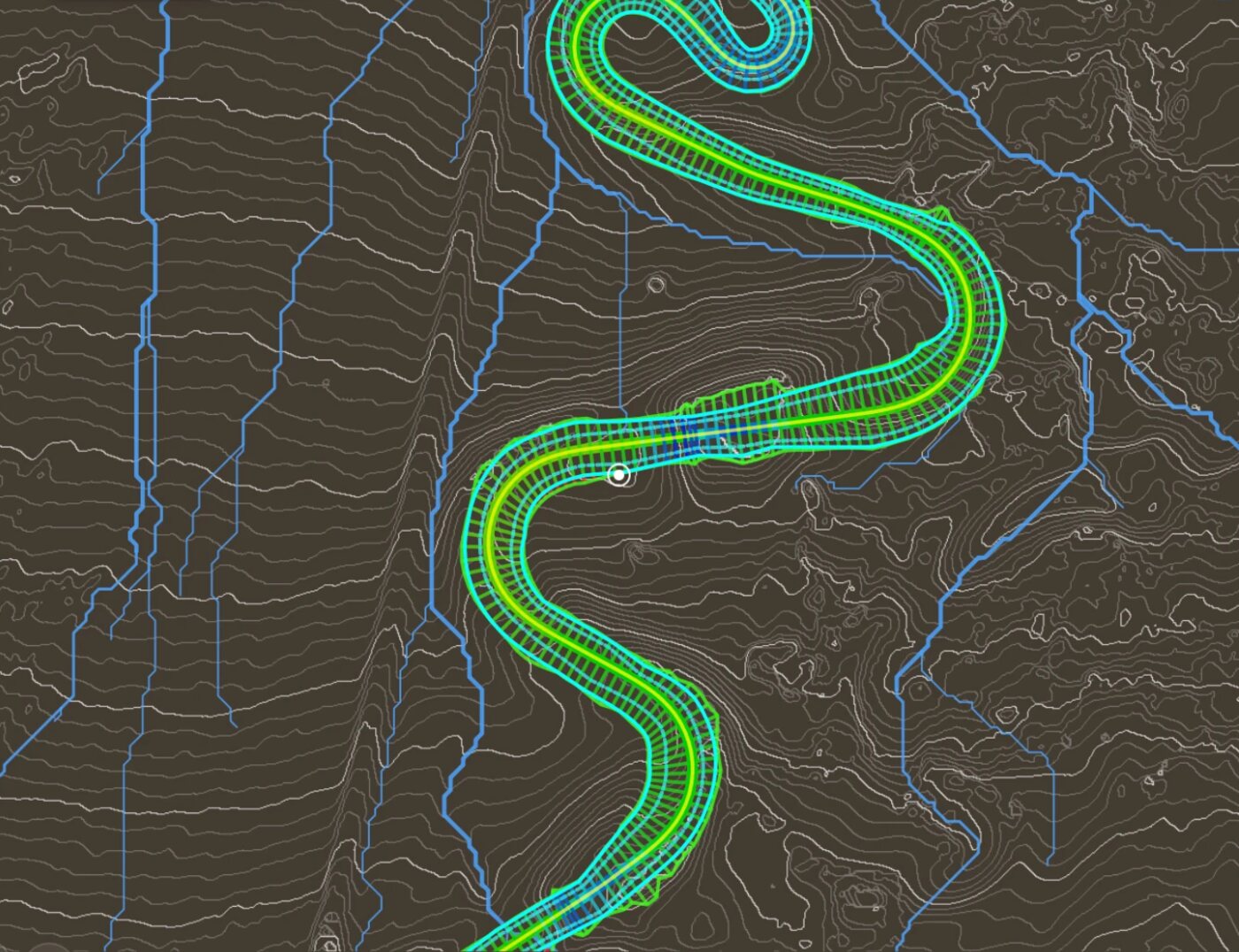
Drone + LIDAR map composite
1

Site, Terrain & Hydrological Analysis

We start with high‑resolution LIDAR, constraint mapping, and hydrological modelling — analysing soil, water flow, catchment areas, and ecosystem factors — so early decisions are based on real data and not assumptions. Understanding how water moves across the site means trails stay rideable longer and require less repair after storms.

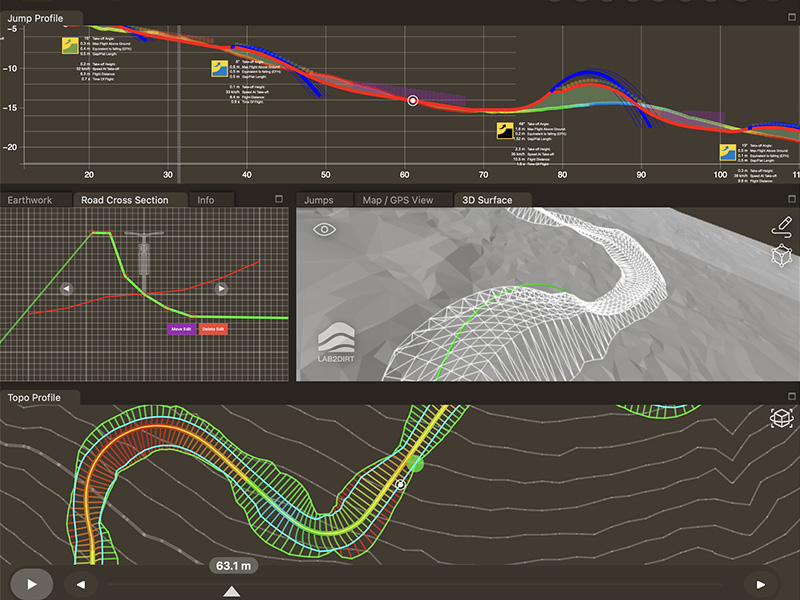
3D trail model screenshot
2

Digital Engineering & Design

Every trail line is designed in a digital 3D model, with speed, flow, jump geometry, and rider experience validated virtually. Design intent matches what gets built — not trial‑and‑error in the field.

Speed/trajectory plot with jump profile
3

Physics Simulation & Safety Validation

We simulate rider dynamics — including speed, trajectories, G‑forces, and landings — to identify risky elements before they exist in the real world. Safety and uptime are engineered, not guessed.

Engineering export and volumes table
4

Permitting Documentation

We produce permitting engineering drawings and technical documentation tailored to local regulatory requirements. We coordinate with local authorities, partners, or civil engineers as needed so your project clears permitting checkpoints efficiently.

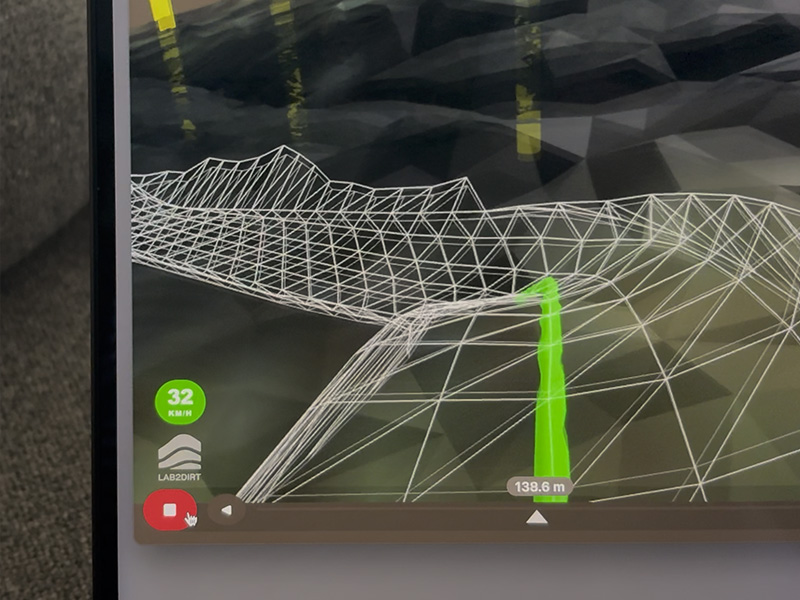
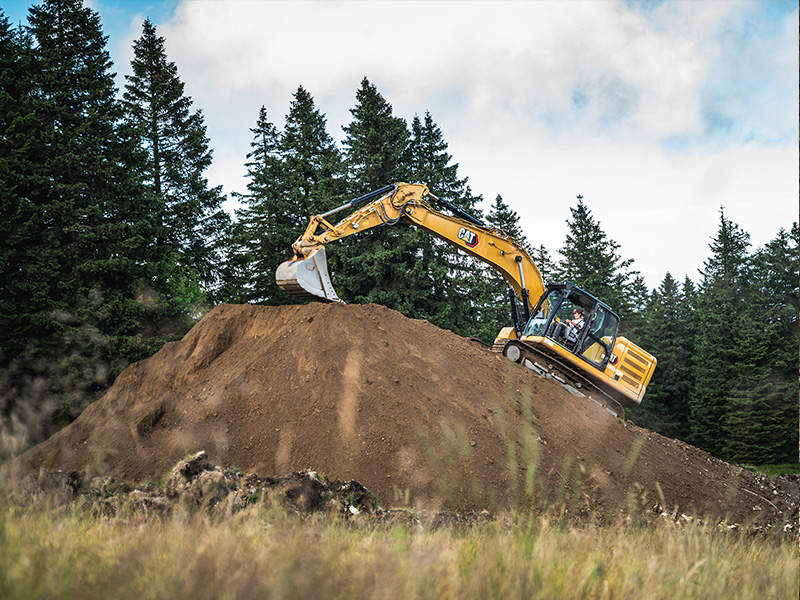
Dozer/excavator with GNSS mast
5

Build Execution & Supervision

Whether we build with our own experienced crew or coordinate with trusted partners, we ensure onsite execution matches the digital model — including construction guidance for machines and crews, sequencing for earthworks and feature shaping, and real‑time validation against design targets.

Maintenance planning with berm measurement
6

Post‑Build Validation & Handover

After construction, we deliver as‑built documentation, safety assessment reports, and maintenance planning guidance. These deliverables help reduce liability, organize future work, and support operations long after opening.

See Our Process in Action

Watch how we transform terrain data into rideable reality

Lab2Dirt Build Process — from terrain data to finished trail (1:44)

Inside Lab2Dirt: Data‑Driven Trail Design

Designing MTB Trails with Digital Terrain Models

Trail Design to Trail Reality

Simulation vs. Reality

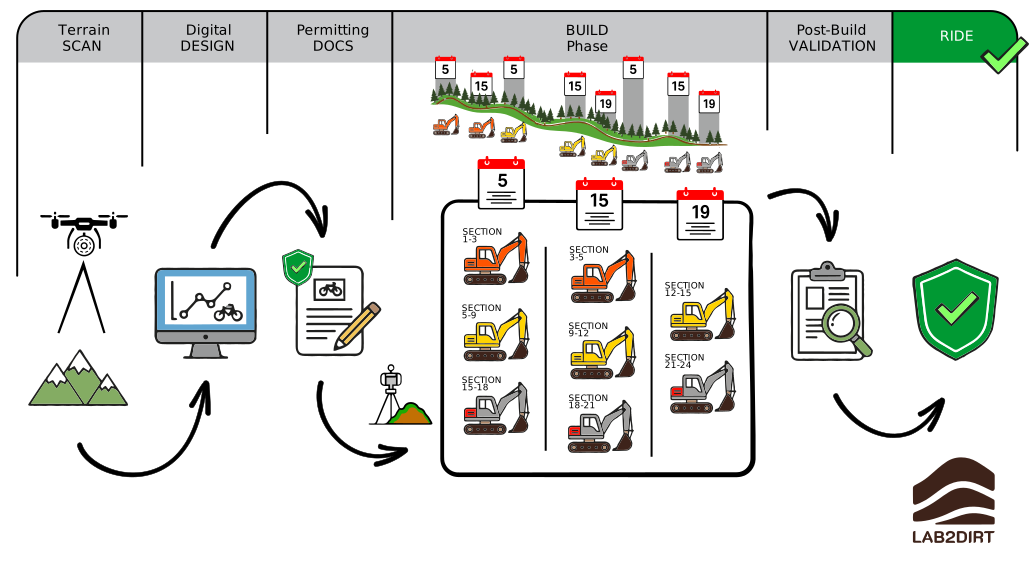
Our Process Timeline

From site analysis to trail opening: a structured, predictable workflow

Six-step engineering process timeline

We can build sections in any order—seamlessly integrating each phase into the master plan without being locked into a linear schedule.

This Methodology Works.
Visit Ferjanka.

Every feature at Ferjanka follows this exact 6-step process. The result? A proven, profitable, repeatable blueprint for building bike parks that riders love.

Why you should see Ferjanka

You're not just hiring consultants. You're partnering with a team that builds. Ferjanka is living proof that our methodology delivers:

  • Safety that works. Every feature validated before riders touch it.
  • Margins that stick. No surprise rebuilds. Predictable maintenance.
  • Riders who return. From kids to pros — everyone loves it.

Ready to Engineer Your Trails?

Let’s talk through your goals — budget, timeline, rider mix, and risk — and map the process to measurable financial outcomes.

Start Your Project